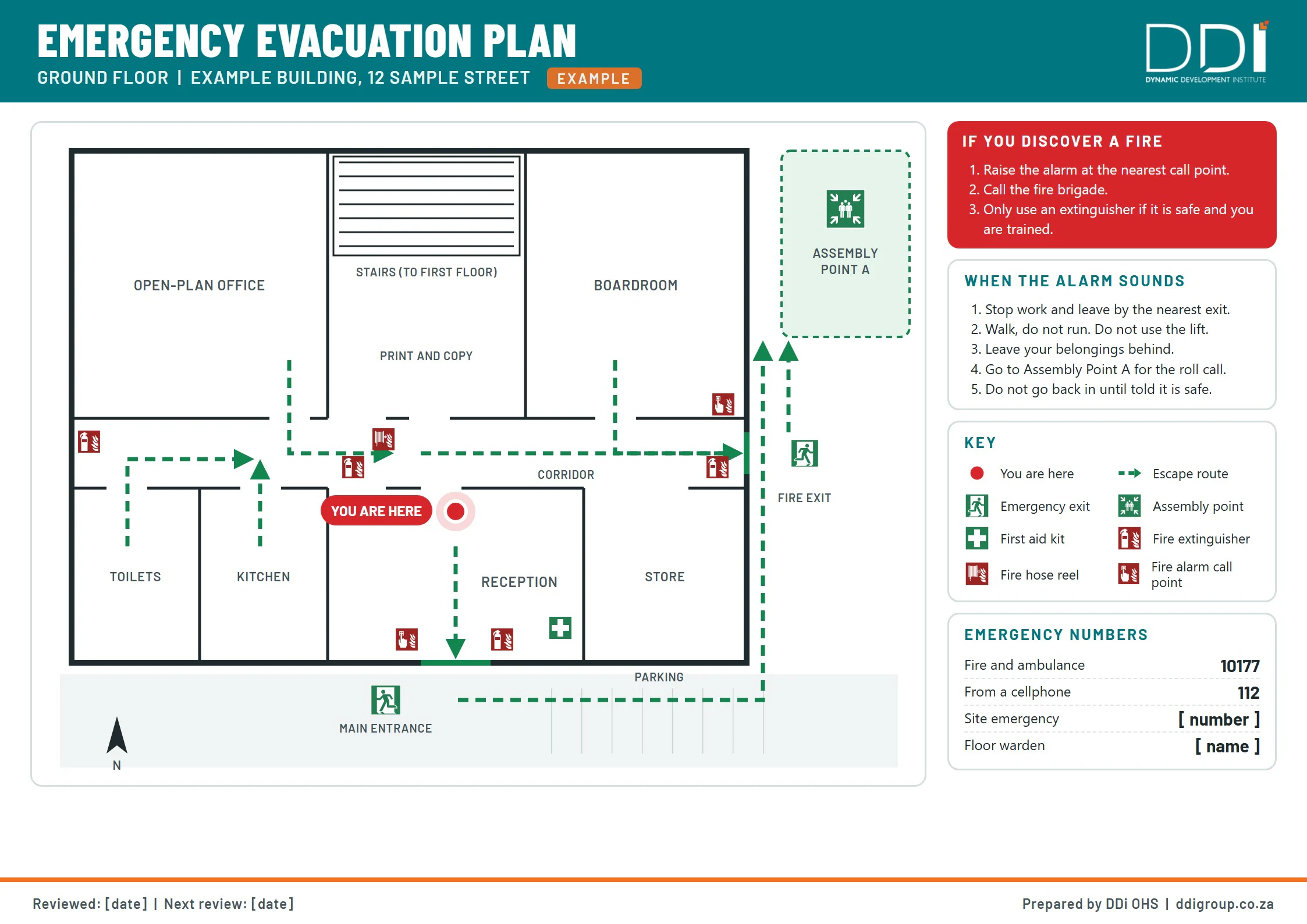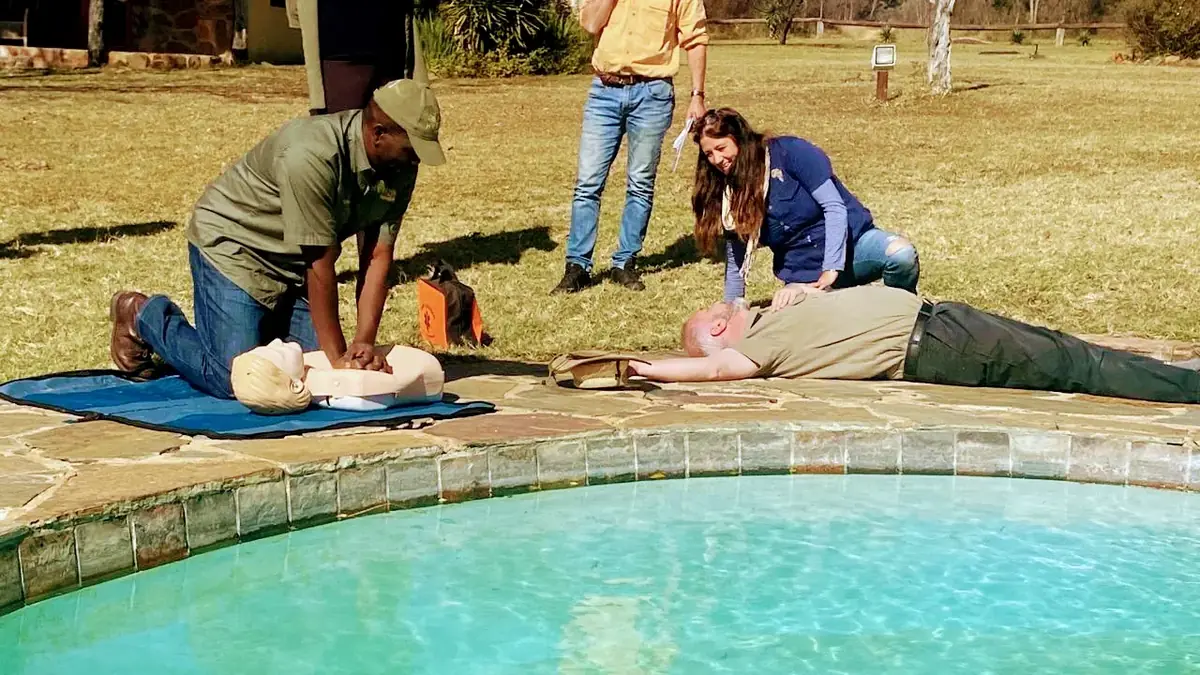












A fire drill is a practice evacuation: you sound the alarm, everyone leaves by the escape routes, gathers at the assembly point and is counted, so you find out whether your plan works before a real fire tests it. No national law sets how often you must run one, but in Gauteng the Tshwane and Johannesburg fire by-laws expect a required evacuation plan to be drilled at least twice a year. This guide gives you a fire drill procedure in eight steps, what the law actually says, and what we have learnt from running drills in offices, factories, schools and multi-storey buildings.
It matters because a real fire gives you minutes, and smoke takes away both visibility and clear thinking. People fall back on what they have practised. Your evacuation wardens are the people who turn that practice into a calm, counted evacuation.
Key takeaways
- A fire drill tests your evacuation plan, your alarm, your escape routes and your roll call in one go, and it builds the habits people fall back on in a real fire.
- No South African law sets one national drill frequency. The Tshwane by-law says a required plan must be tested at least every six months, and Johannesburg's says it should be drilled at least twice a year.
- Both Gauteng metros expect a by-law drill to be announced about three weeks ahead. Unannounced drills are an extra, cleared with management, security and the alarm company first.
- Every drill needs a written record: date and time, how many took part, the outcome, the corrective actions and who signed it off.
- The most common failure is not the fire. It is people who are not where the roll call thinks they are.
What is a fire drill (and what it is not)?
A fire drill, also called an evacuation drill, is a rehearsal of your emergency evacuation. It is not fire fighting. Fire fighting is a small group using extinguishers on a fire in its first minutes, which is what Basic Fire Fighting teaches. A drill is about getting everyone else out and accounted for, quickly and without panic. The two work together, and the difference between fire prevention and fire fighting is worth understanding before you plan either.
A drill does four jobs at once:
- It builds muscle memory. Under stress people do not read signs. They do what they have done before.
- It tests the plan. Many written evacuation plans have never been tested. A drill shows the alarm nobody hears in the back office and the assembly point that sits too close to the building.
- It checks the timing. A slow drill shows you exactly where the bottlenecks are.
- It proves the roll call works, including visitors, contractors, night shifts and other tenants in the building.
What the law says about fire drills in South Africa
There is no single South African rule that says "run a fire drill every X months". The duty is built from several instruments:
| Law | What it says about evacuation and drills |
|---|---|
| Occupational Health and Safety Act 85 of 1993, sections 8 and 9 | The employer must provide a workplace that is safe as far as reasonably practicable, with the information, instructions, training and supervision needed (section 8(2)(e)). Section 9 extends the duty to visitors and contractors. No drill interval. |
| General Safety Regulations, regulation 13J (2025) | Escape doors, fire escapes, escape routes, at least two means of egress, and fire-fighting equipment that is maintained. No drill interval. |
| Construction Regulations 2014, regulation 29(l) and (m) | An effective evacuation plan so that everyone can be evacuated speedily without panic and accounted for, and a siren sounded in a fire. No drill interval. |
| Tshwane Fire Brigade Service By-laws, 2016, section 40 | A required evacuation plan must be tested in full at least every six months and recorded in a register. |
| Johannesburg Emergency Services By-law, 2004, sections 17 and 18 and Schedule 1 | A designated building's evacuation plan should be drilled at least twice a year, with 21 days' notice to everyone taking part. |
| Mine Health and Safety Act 29 of 1996 | Mines fall outside the OHS Act and have their own emergency preparedness rules. |
What happened to ERW regulation 9?
For years, fire precautions and escape routes sat in regulation 9 of the Environmental Regulations for Workplaces, often written "ERW9". On 6 March 2025 the same wording became regulation 13J of the General Safety Regulations, and regulation 9 was deleted in December 2025. Contravening regulation 13J is an offence under regulation 14, with a fine or up to six months' imprisonment. If your fire safety documents still quote ERW9, the same rules now sit in regulation 13J.
Gauteng: the Tshwane and Johannesburg fire by-laws
The Fire Brigade Services Act 99 of 1987 lets each municipality make its own fire by-laws, and that is where drills become specific. In Tshwane, section 40 of the 2016 by-laws applies to premises the fire service designates. Section 40(3) also requires a plan, without any designation, for schools, hospitals, hotels, guest houses, hostels and similar buildings with more than 25 people. Section 40(5) says the plan "must be tested in its entirety at a minimum of six-monthly intervals". Johannesburg's Schedule 1 says a plan "should be drilled at least twice each year" and involve everyone who works or lives in the building. If you are outside these two metros, check your own municipality's fire by-law.
How often should you run a fire drill?
Twice a year is the right answer for most workplaces, and never less than once. In Tshwane and Johannesburg that is what the by-laws expect where an evacuation plan is required. Everywhere else, the frequency belongs in your emergency plan and follows your risk assessment, any conditions the fire department set when it approved the premises, and your client or sector requirements.
Drill more often where the risk is higher. A petrochemical site storing highly flammable liquids and gases, a busy multi-storey building, or a workplace with high staff turnover all need more practice than a small single-storey office. Run an extra drill whenever the layout, the alarm or the emergency team changes.
Fire drill procedure: 8 steps
This is the fire drill procedure we follow at DDi, from the first meeting to the report:
- Brief management. Agree the date, the scenario and whether the drill is announced or unannounced.
- Notify the right people. Give staff written notice for a by-law drill. Always tell building management, the security company, the landlord if it is a separate company, and the alarm company, so nobody sends a fire engine for a practice.
- Prepare the wardens and observers. Place observers at stairwells, exits and the assembly point, each with a checklist. On an announced drill, walk wardens through where to stand and what to do.
- Sound the alarm. Use the building alarm if it can be reset, or an air horn or whistle in a small workplace.
- Evacuate. Walk, do not run, use the stairs and never the lifts, close doors behind you and leave belongings. We tell people that slow is smooth, and smooth is fast.
- Sweep the floors. Wardens check toilets, storerooms and meeting rooms, then report their floor clear.
- Do the roll call at the assembly point. Count staff, visitors and contractors against a list, report the result to the person in charge and stop the clock.
- Debrief and record. Before people go back inside, discuss what worked and what did not. Then write the drill into the register with its findings, actions, responsible people and dates.
Announced or unannounced?
Both have a place. An announced drill teaches: it is slow and methodical, and everyone learns the route. A by-law drill is announced, and Johannesburg's by-law asks for 21 days' notice to everyone taking part. An unannounced drill tests: only top management knows, and you see what people really do. On unannounced drills we sometimes stage a medical case on the stairs or use a smoke machine, with the fire brigade, building management and security warned beforehand so no resources are wasted. In a small business a basic unannounced drill with an air horn is often enough. In a medium or large one, notify the authorities and follow the by-law.
How long should an evacuation take?
No South African law sets a time. Our target for a typical office of 50 to 100 people is everyone out and the roll call done within two minutes. The best drills we have run came in just under two minutes. The slowest took about ten, which is far too slow. The time matters less than the trend, so measure every drill the same way and compare.
What usually goes wrong in a fire drill
After years of drills, the same problems come up again and again:
- People do not take it seriously. "It's just another fire drill" slows everyone down. The debriefing is often when it becomes real.
- Nobody knows their job. Must I clear the floor? Must I take the first aid kit? Training without practice leaves this gap.
- The wrong assembly point. With two assembly points, people go to the other one and are marked absent while standing safely somewhere else.
- Belongings. People stop to fetch bags, laptops and car keys.
- Visitors and contractors who are on nobody's list.
A drill at one client showed how many of these gaps sit in the paperwork rather than the people. The emergency team had no written appointments, there was no chart showing who reports to whom, the roll call relied on handwritten notes and clocking data, there was no central control point and no two-way radios, and the manual alarm activation failed. Nobody had a procedure for releasing the magnetic doors. People ran, some in high heels, and the assembly point next to a road needed cones to protect them from traffic. Every one of those findings was fixed because a drill exposed it, not a fire.
The person in the cupboard
Years ago we ran a drill in a multi-storey office building. On the 12th floor we asked one person to hide in a cupboard and not answer their phone. After the evacuation, with ambulances on site as part of the exercise, we asked whether everyone was accounted for. The answer was yes. Then we phoned the person in the cupboard. In a real fire, that "yes" could have cost a life. A roll call is only as good as the list behind it.
Blocked exits, by contrast, rarely show up in our drills. That is because we audit the escape routes before we run one. In audits we find it often: exits that are locked, gates nobody has the keys for, doors that do not open. Fix those first, then drill.
Who does what: wardens, fire fighters, first aiders and security
An evacuation runs like a well-built machine when every role is appointed in writing and practised:
- Incident commander: takes charge, receives the floor reports and the roll call, and briefs the fire brigade.
- Evacuation wardens: clear their floor and report it clear. We recommend at least one per floor, and two to four on large floors, working as a team down the stairs.
- Fire fighters: deal with a small fire only if it is safe to do so.
- First aiders: look after anyone hurt or unwell at the assembly point.
- Security: trained to help clear floors, hold the visitor list and meet the fire brigade.
Your SHE representatives play a part too, through the inspections and records covered in our SHE rep checklist.
Your fire drill register: what to record
Health and safety runs on evidence. When an inspector asks about emergency preparedness, they want proof that drills happen, and the record belongs in your health and safety file. Tshwane's by-law, section 40(6), lists what the register must contain:
- the date and time of the drill
- the number of people who took part
- the outcome and the corrective actions
- the name and signature of the person who supervised it
We add the location, staff, visitors and others counted separately, the evacuation time, the roll call result, and for each problem the action, the responsible person and a date. Our full drill report also covers the pre-drill briefing, how the drill ran, attendance, observations, the scenarios discussed in the debriefing, findings and non-conformances, and recommendations. For larger sites we add an event tree: if the alarm sounds, do the magnetic doors release? If not, who overrides them? If the alarm fails, is there a backup, and how do wardens communicate?
Drills at schools and crèches
Schools are among the easier places to drill, because teachers know who is in their class and schools usually have set assembly points. Tshwane's by-law requires a plan at any school with more than 25 people. Crèches are harder. Babies cannot walk, so you need more staff per child, and stressed children move slowly. Make it a game, sing songs and keep moving. Calm, fun and quick gets small children out safely far better than shouting.
Learning from a real evacuation
Drills are not theory for us. In 2026 we were on the scene of a fire at a paint factory in Centurion, where many people had to be evacuated. The fire department asked us to help evacuate the neighbouring companies too, because the products involved were highly flammable and lives nearby were at risk. In a real fire nobody has time to read a plan. People do what they have practised.
How DDi helps
We help in three ways:
- Evacuation Warden training for the people who clear your floors and run the roll call.
- Basic Fire Fighting for the team that tackles a small fire safely.
- Planned and unplanned drills with observers, a debriefing and a written report, on their own or as part of OHS Navigator.
Not sure when your last drill was, or whether it was recorded? That is the place to start. Contact DDi to train your wardens or book your next fire drill.
The course for this topic
Onsite from R605 per person for 20 or more (R790 for 5 to 9), excl. VAT. Or the same per-person rate for a private online session for your team, no travel.
For employees appointed as evacuation wardens or fire marshals, and the floor, area and shift leaders who take charge in an emergency.

Stephan writes and reviews the DDi OHS blog. About DDi OHS