











An OHS consultant is an outside health and safety specialist who works out where your business stands against the Occupational Health and Safety Act and then helps you close the gaps. In practice that means a gap analysis, the risk assessment, your safety file, legal appointments, training, audits, incident investigations and support when an inspector arrives. What a consultant cannot do is take over your legal responsibility: under section 16 of the Occupational Health and Safety Act 85 of 1993, the CEO stays accountable for health and safety.
That split matters when you hire one. You want someone who does the work properly and leaves your business able to show an inspector it is in order. Below are the seven core jobs, what stays with you, when a business needs a consultant and what to look for. DDi's own consultants work this way in OHS Navigator, our monthly health and safety retainer.
Key takeaways
- An OHS consultant assesses your compliance with the OHS Act and does the work to close the gaps, from the risk assessment to inspection support.
- The employer and the CEO stay legally responsible. Section 16(2) lets the CEO assign duties to a person under their control, but not hand off the accountability.
- Outside construction, the law sets no registration for OHS consultants. On construction work, agents and construction health and safety officers must be SACPCMP registered.
- Most consulting starts with a gap analysis, then either once-off work (an audit or a safety file) or a monthly retainer.
The 7 core jobs of an OHS consultant
- Gap analysis. The consultant visits, looks at your workplace, your records and the way work is done, and lists what is in place, what is missing and what to fix first. Each gap should be tied to the part of the Act or regulations it falls under, so you know why it matters.
- Risk assessment. Section 8(2)(d) of the OHS Act requires employers to establish, as far as is reasonably practicable, what hazards are attached to the work, and to put precautions in place. The consultant runs or updates your risk assessment (HIRA) with your team.
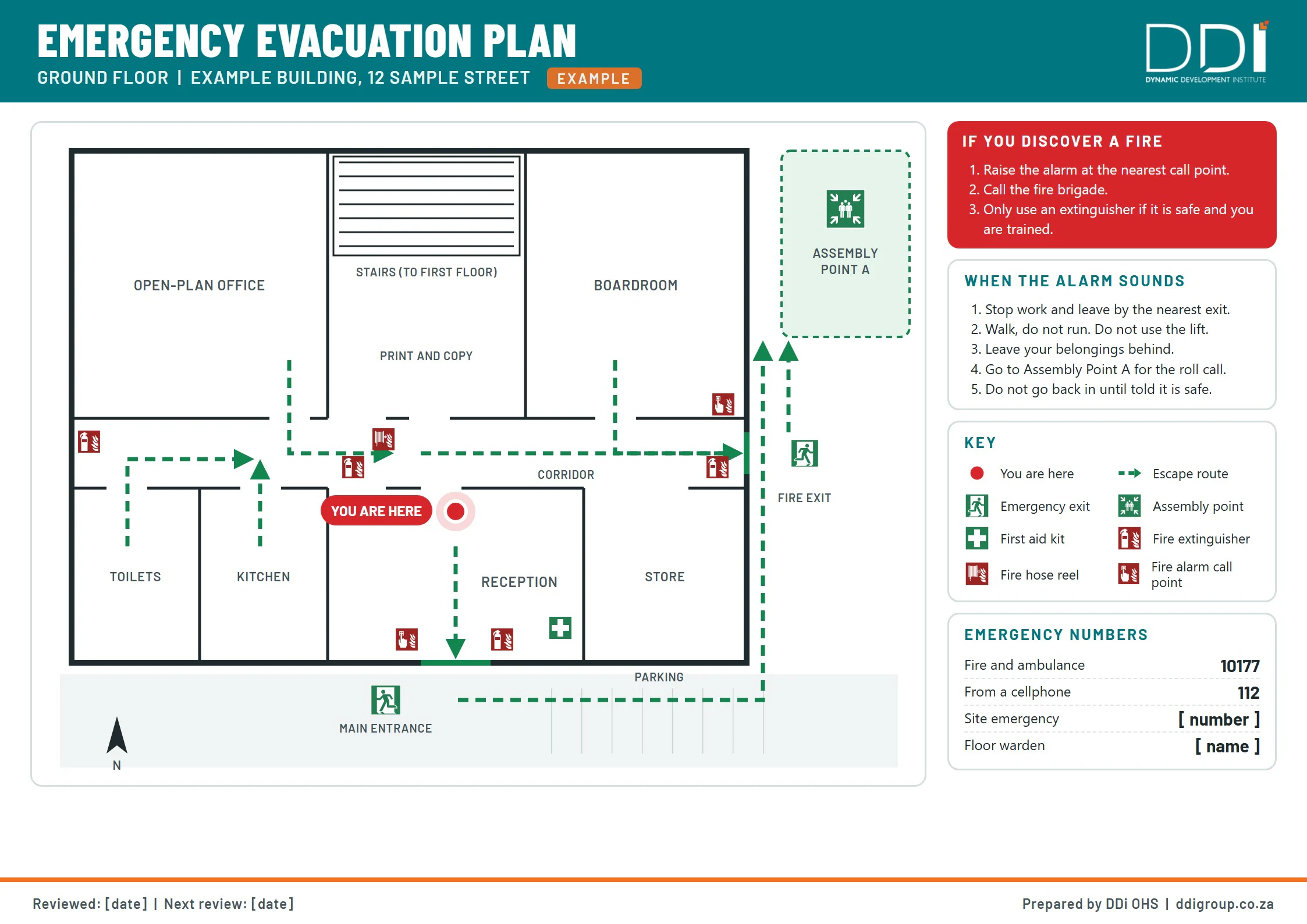
- The safety file. The consultant compiles your health and safety file: the policy, risk assessment, appointments, training records, incident register, emergency plan and inspection records, and keeps it current.
- Legal appointments. The consultant prepares the appointment letters the Act calls for and checks you have enough people in each role. SHE Reps are required once a workplace has more than 20 employees, one for every 100 in a shop or office and one for every 50 elsewhere (section 17). First aiders are required above 10 employees (General Safety Regulation 3(4)).
- Training. A consultant either trains your people or arranges it: first aiders, fire fighters, SHE Reps and the managers who carry appointments. See SHE Rep Training and First Aid Level 1.
- Audits and inspection support. A consultant checks your workplace against the Act on a schedule, and helps you through a Department of Employment and Labour inspection. If the inspector issues a notice, the consultant drafts the response and the corrective action plan with you.
- Incident investigation. When something happens, the consultant helps you report it where section 24 requires it, record it in the incident register and investigate it so it does not happen again.
What stays with you
A consultant does the work. The responsibility stays in your business:
| The consultant can | What stays with you |
|---|---|
| Prepare the 16.2 appointment and train the person | The CEO's accountability (section 16(1)) and the 16.2 appointee, a person under the CEO's control (section 16(2)) |
| Train and support your SHE Reps | Designating SHE Reps from your own employees (section 17) |
| Write and update the risk assessment and safety file | Putting the controls in place every day |
| Help you through an inspection | Answering for the workplace as the employer |
| Advise on construction work | Appointing a registered construction health and safety officer where Construction Regulation 8(5) requires one |
Put the arrangement in writing. Section 37(2) of the OHS Act makes an employer answerable for what a mandatary, such as a contractor or consultant, does, unless the two have agreed in writing on how the mandatary will comply with the Act.
When does a business need an OHS consultant?
Most businesses that call a consultant are in one of these situations:
- Nobody inside the business has the time or the know-how to keep health and safety current
- The business has grown past 10 or 20 employees and now needs first aiders, SHE Reps and a committee
- A client, tender or registration asks for a health and safety file you do not have yet
- An inspector has visited, or issued a notice. Here is what an inspector asks for first.
- Something has gone wrong and you need an incident investigated properly
- You use several suppliers for training, files and audits and want one partner instead
Weighing a consultant against hiring your own safety officer? Read in-house safety officer vs outsourced health and safety.
What to look for in an OHS consultant
Outside construction, South African law sets no registration for an OHS consultant, so you have to check the person and the company yourself. Ask:
- Experience in your kind of workplace: an office, a warehouse and a factory carry different risks
- Professional standing: qualifications and membership of a professional body, for example a SAIOSH designation
- Construction registration, where it applies: the Chief Inspector approved the SACPCMP to register construction health and safety agents, managers and officers (Government Notice R85 of 2014), and Construction Regulation 8(6) says a contractor may only appoint a registered construction health and safety officer
- A written scope: what they do, how often they visit, what you receive after each visit and who answers when an inspector arrives
- Who does the work: the person who sells the service should not be the last you see of it
- References from businesses like yours
DDi's posts are written by Stephan Heyneke (GradSaiosh).
How OHS Navigator works
OHS Navigator is DDi's OHS consulting service on a monthly retainer, built around your business rather than sold as a package. We start with a gap analysis against the OHS Act. From what it finds, we build a plan sized to your headcount, sites and risk profile, and agree the scope with you up front. Then we carry it out: your safety file, risk assessments, legal appointments, training, a site visit every 3 months and support when the Department of Employment and Labour inspects. Prefer a once-off check first? Book an OHS compliance audit.
Ready to see where your business stands? Start with a gap analysis.
Our service for this topic
Priced on a quote for your workplace.
For employers who want training, audits, safety files and inspection support from one partner.

Stephan writes and reviews the DDi OHS blog. About DDi OHS